Showing posts with label Palazzo Farnese. Show all posts

Wednesday, April 28, 2010

PALAZZO FARNESE to the VILLA FARNESINA

Getting away from the crowds and noise of the Campo de' Fiori means a very short walk to the spacious and elegant Piazza Farnese. We favor sitting here at an outdoor table at the Bar Farnese enjoying our first cup of cappucino or campari before dinner . Positioned on the piazza is Osteria AR Galletto, a restaurant that has continued here since the 1500's. A few nights ago we dined here on a very Roman meal of pepe e cacio ( spaghetti w/roman pecorino and pepper), followed by grilled lamb and galletto ( game hen) flattened and grilled with a side dish 0f carciofi alla Romana(artichokes ),we imagined that Michelangelo might have sat in this exact spot for dinner. A very enjoyable evening.


Palazzo Farnese
Rome is about beauty and power. In the past Rome's power was in the hands of a few wealthy families and the papacy. Follow the names Della Rovere, Borghese, Barberini, and Farnese and that will lead to a Pope. The Farnese family, with the then cardinal, soon to be Pope Paul III, commissioned Sangallo the Younger (1514- 89) to design this dominant palazzo. Later Michelangelo was brought in to complete the project by changing the design to heighten the top floor to give the building visual lift. This change gives the facade a dynamic proportion, defying its own weight.


In the evening, sitting in the Piazza Farnese looking up to the Palazzo Farnese the interior is illuminated revealing the beautiful frescoed ceilings by Annibale Carracci. The Palazzo is now the French Embassy and is not open to the public. We found that it was possible to arrange a visit by contacting the embassy several months in advance so we were fortunate to be able to schedule a tour and see these marvelous frescos.


As one might imagine, photos are not allowed so the Carracci fresco images are from the catalog.

We had seen this fresco reproduced in books but were awestruck when standing in the great hall surrounded by the massive work of art. Truly amazing.


Much of the palazzo's beauty is hidden to the public such the inner courtyard and the garden. The building was designed to face the Tiber River (not the piazza), where there is a loggia and the garden.


Michelangelo's Bridge

Pope Paul III (Farnese) hired Michelangelo to design a private bridge connecting the Palazzo Farnese to the Villa Farnesina. The bridge was to go over the Via Guilia and span the Tiber River, the project was never totally completed. (see previous blog on Via Guilia).


Enough looking...............let's eat!

From the Piazza Farnese we walk to the Piazza Navona to make a brief visit to Santa Maria Della Pace to find it closed. However, we visit the cloister designed by Bramante. It is worth the visit.
A couple of blocks north we return to one of our favorite restaurants, Hosteria l'Orso 80. We order a glass of Montefalco Rosso and a glass of Nebbiolo and settle in. Orso 80 is renown for its antipasti plates. We choose the antipasti di mare.


Our primi piatti was perfectly prepared bucatini all' amatriciana (see above!). Secondi piatti was Saltimocca and the other Rombo all Forno (Turbo) a whole fish boned tableside. Both plates were served with roasted potatoes.
Era squisto!


The waiters and staff are welcoming, friendly and a bit sarcastic! Dining here it is important to remember that you are here for the food not the 'art' on the walls!


Outside the Villa Farnesina

After lunch we walk back across the Tiber to Trastevere to complete our outing with a visit to the Villa Farnesina. Our feet still aching from walking on the ancient Roman cobblestone streets, we venture forth to this Renaissance villa built in 1511 by the Chigi family. Agostino Chigi was a wealthy banker from Siena and friend to
Pope Leo X (Medici). It was said that banquets given by Chigi were so lavish that to impress his guests he would have his servants throw the silver platters into the Tiber after dinner. Rumor also has it that there were nets in the river so that the servants would secretly fish the platters out of the river the following day.
We visit the villa Farnesina to see the Raphael fresco 'Galatea' as well as Peruzzi's trompe l'oeil fresco in the Sala delle Prospettive. We are most taken by the fresco painted by Sodoma in Chigi's bedroom. We agree it is the finest fresco that we have seen by Sodoma. Pretty hot stuff Renaissance style!
The villa is quite beautiful and the frescos through out fresh and wonderful.

Time to head back up the hill once again to the Gianicolo and dinner at the Academy.


Thursday, April 22, 2010

A WALK DOWN THE VIA GIULIA and LUNCH


The Ponte Sisto crosses the Tiber River from Trastevere and brings us to the Via Giulia. The Via Giulia was conceived by Pope Julius II (reign 1503-13) and laid out by his chief architect Bramante. The Via Giulia is one of the nicest walking streets in Rome.


During the 16th century neighborhoods were destroyed to establish this straight avenue that connects the Forum area to the Vatican.


In the back of the beautiful Palazzo Farnese, now the French Embassy, is the Fountain of the Great Mask, the type of Roman relic often seen around the city.


Michelangelo completed the design of the Palazzo Farnese and was commissioned to design a bridge to span the Tiber and connect the Palazzo Farnese to the Villa Farnesina as a summer house in Trastevere. Both the Palazzo Farnese and Villa Farnesina have amazing frescos by Carracci, Raphael and Sodoma, more about this in a future posting.


Palazzo Falconieri
There are massive Renaissance villas in Rome. The elements that reflect traditional Renaissance architecture are rough blocks of Travertine on the ground floor (rustication), monumental doorways, balconies and wide overhanging cornices. (good refuge during a rain shower!)


Along the Via Giulia there are many small fine antique shops.


We pause for caffe latte at a table outside on the Via Giulia, taking time to look at the buildings that surround us.


Sant Eligio
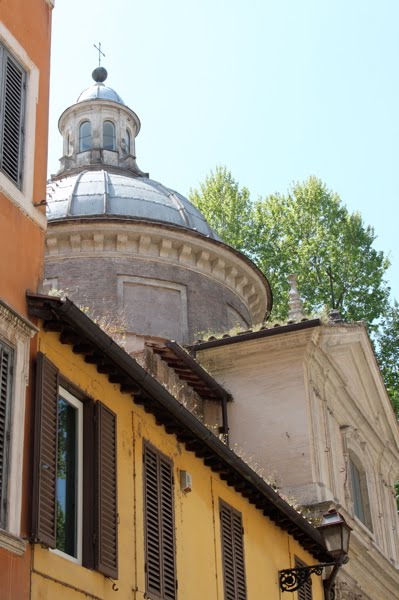
Just off the Via Giulia is the tiny pink and white church of Sant Eligio. It was designed by Raphael and it reflects perfect Renaissance proportions.


Tempietto, (Bramante,1499-1502)


Sant Eligio
The domed cupola is related to the beautiful Tempietto, designed by Bramante, on the Janiculum Hill (Giancolo,near the American Academy). Both domes influenced the great dome of St. Peters , begun by Bramante and completed by Michelangelo.


The street is designed and laid out to be a straight passage for pilgrims to reach St . Peter's .


Via Giulia, 85 , the house of Raphael.
The property on the Via Giulia was prime real estate and highly sought after. Raphael along with other artists bought property here. Continuing past Raphael's house the Via Giulia comes to an end at the Florentine Church, Basilica di San Giovanni dei Fiorentino. From her it is an easy walk over the Tiber to St. Peter's Basilica.


So now it is time for lunch. we go to one of our lunch favorites Grotte del Teatro di Pompeo, Via del Biscione, not far from the Campo de' Fiori. If we are in this area in the evening we might choose Ristorante Pierluigi for dinner. We adore the tables in the Piazza de Ricci, and the fish is fabulous.


Here we meet the owner Lino, always a wonderful host. We get to review the days antipasti selection. Here the seasonal vegetables and the artichokes now reign supreme.


The freshest fish (pesce) is always available, just pick what you like.


Antipasti de vedura, grilled eggplant and zucchini, roasted peppers potatoes, fritata....and sorry, we ate the artichokes !


Insalata di alcette e rughetta (arugula salad with fresh baby anchovies), a totally different arugula and anchovy. How can such simple ingredients come together so perfectly?
Era squisito!!!!
Our next course was recommended by our waiter, it was pasta with gamberoni (shrimp) in a light, but spicy tomato sauce with garlic. We followed this with a cleansing lemon sorbet served in a champagne flute.


We end the day under Bernini's colonnade (colonnato) at St. Peter's.
Buongiornata!

Monday, April 5, 2010

ANTICIPATING ROME

The Pantheon
Pliny the Elder ( Born 23CE) noted naturalist, lawyer, historian and author, was sent to Rome for his education. Anticipating Rome we think about the long history that remains so alive there. The masterpieces created by great artists and architects are apparent and hidden, so many gems to see. The names Borromini, Bramante, Bernini, Carravaggio,Sangallo, Carracci and Raphael all come to mind.
The Pantheon is perhaps the greatest ancient intact surviving building and it is here in Rome. Arriving in Rome we make it our first stop. Walking into the Pantheon we first feel the most incredible sense of space, standing in a sphere the only source of light is the 26' circular opening.We once stood under this oculus to watch a feather float down from that famous opening to the sky. We stood watching as it slowly,slowly drifted to the floor.
A detail of a Raphael fresco from the Raphael Rooms at the Vatican Museum

Raphael was greatly loved by the Romans. He died young and is entombed in the Pantheon. People still leave flowers by his tomb.

The Palatine Hill is the neighborhood of the ancient Roman emperors. It is a beautiful place for a walk with views over the ancient Roman forum. We are looking forward to visiting the ruins of the House of Livia, and the house of her husband Augustus (1st Emperor).
A walk down to the Jewish Ghetto will lead to a number of good places to eat. Worth a return for lunch is La Vecchia Bottega Del Vino, they serve a wonderful "piatto unico" of salad and antipasti.
Via Giulia is a street that from the Forum to the Vatican decreed by Pope Julius II . Michelangelo designed this bridge over the via Guilia from the Palazzo Farnese to cross the Tiber and connect to the Palazzo Farnesina. The total span was never completed, the bridge does not cross the river. Via Guilia is a marvelous street to walk,and a point of interest is that Raphael here.

Flowers in the Campo de Fiori
Daily market (except Sunday), the best of what Rome has to offer in fruits, vegetables, cheeses, meats, flowers, etc. It is hard to resist buying bags full of food, it is all so fresh and the flowers so beautiful. There is also pizza bianca to be found here. What a treat to spend time here!
Art, architecture,ancient streets, gardens gracious Romans and incredible food and wine,
we anticipate it all.