Showing posts with label Val d' Orcia. Show all posts

Wednesday, April 15, 2015

San Quirico d'Orcia and Bagno Vignoni

BAGNO VIGNONI


 I learned about this town from our friends Janelle and Johnny and since the day was warm and sunny James and I decided to make a visit. Bagno Vignoni is located in one of the most beautiful regions of Tuscany, the Val d' Orcia.
Tiny Bagno Vignoni  is known for it's thermal spring in use as far back as Roman times. The Piscina, or pool which dominates the piazza was built  and used by the Medici family. Lorenzo d'Medici went to the thermal spa in hopes of a remedy for his gout. He was in such pain he had to be carried around  and he likely died in his 40's from complications due to gout, or so I've read.....so perhaps the thermal waters never did cure his gout.


There is a quiet serenity here created by this pool, which in itself could be calming and healing.  A walkway and handsome buildings surround the water filled piscina.
James and I found an enoteca where local cheeses and cured meats were featured, along with wines of the region. There are several places here to eat as well as a hotel that does have a thermal spa that is in use.


Rocca d'Orcia is another well preserved Medieval village that is on a hill  side in the distance towering above Bagno Vignoni. The castle makes for a spectacular focal point in the distance and must have been a very strategic location in the 12th Century.


SAN QUIRICO D'ORCIA


After lunch, we drove to San Quirico d'Orcia. I have seen signs for this town for years, but we have never stopped since there has always been a different destination planned and we drive past. Today was the day for San Quirico d' Orcia.

It was after lunch, so the shops were all closed, but we were here to look at the town itself, and the churches were open as well as a rose garden. The largest church in town is the 12th Century Romanesque  Collegiata.


After a visit to the Rose Garden we discovered an allee of Ilex trees that lead to the Collegiata. Interesting to find that this was constructed to give a shady and restful place for the pilgrims walking the via Francigena, a Medieval holy route from France to Rome.
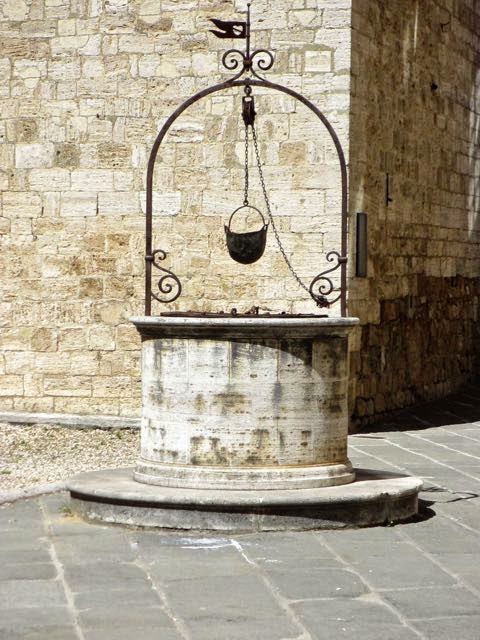


This  finely preserved well stands proud at the corner of the Collegiate


 Sandstone lions  support figures that are the columns supporting the arch. This dates somewhat later than the building itself and is attributed to Giovanni Pisano.


There was some damage to the exterior of the church during shelling in World War II.


A column supported by a Lombard lion, a very ornate portal and unusual for this region.


The Chigi Palazzo was built in 1697 for cardinal Flavio Chigi. The Chigi family were wealthy bankers in Siena and eventually Rome, where wealth, power and the church all were intertwined.

The main street,Via Dante Alighieri is lovely. It is lined with small shops and trattorias housed in buildings that date from the Medieval and the Renaissance. Due to the fact that San Quirico was on the pilgrim route there were in the 13th C. several small hospitals and hostels to care for them on route to Rome. It is said that St. Catherine of Siena stayed in a house here along the Via Dante Aligheri. 


The Val D' Orcia


Both San Quirico D 'Orcia and Bagno Vignoni are in the Val D'Orcia region of Tuscany.
The entire Val' D' Orcia is a UNESCO site. The beauty of this part of Italy is overwhelming.

The Val D'Orcia is one of my "Thin Places", a place where heaven come together.
It is hard to explain, it is a feeling that overcomes you when you are there in it's midst.
It is a powerful place who's memory lives within you even after you leave.


Thursday, July 10, 2014

La Foce ..... a pilgrimage to the gardens (Tuscany)


The garden and villa of La Foce are  the legacy of two quite amazing, if not heroic individuals, Iris and Antonio Origo.
  Together, with esteemed architect and garden designer, Cecil Pinsent, a masterpiece was created.

In 1924, Iris and Antonio purchased the run down  Tuscan villa and with their vision created the wonderous place that is La Foce.
La Foce means" a meeting place", in this case it refers to the place where two valleys meet,
 the Val d'Orcia and the Val di Chiana,  one of the most magical places James and I have visited.
To visit La Foce is more a pilgrimage than a garden tour.


The Pinsent designed Limonaia that houses the lemon trees during the winter months.


James and I made our most recent visit to La Foce in late May so the lemon trees had taken their places in the garden.


We have visited La Foce often, usually in early spring when the wisteria is in full bloom. Our visit this past spring was later, after wisteria but with the lemon trees out of the limonaia and in the garden, along with the roses coming into bloom.


The garden is the centerpiece of a visit here , but beyond is the incredible story of Iris and Antonio Origo and the history of La Foce.
 In 1924 when they purchased the villa, the surrounding landscape, known as 'crete senesi' was that of hardened clay.
It was barren. Some call in a "moonscape".
Iris and Antonio dedicated their efforts into creating a land that could be farmed to produce  food and income for the impoverished families of the Val'd Orcia.


 Work began to improve  the condition of the land and bring farming to the Val'd Orcia, meanwhile, architect Cecil Pinsent was hired to work on the villa and create a garden at La Foce.
Iris hired Pinsent,  for the garden design because she herself imagined a garden like those she knew from her home, Villa Medici in Florence, geometrical and of formal order.

Standing atop the staircase that descends to the lower garden, you can see
 the landscape of the Val d' Orcia centered on Mount Amiata. This is an important idea, the viewer sees the lush ordered green of the garden and then beyond to the beautiful vista of the ordered landscape of Tuscany and  farther yet, Mt. Amiata.


This formal staircase with grotto, designed by Pinsent, takes one from the upper garden into the lower garden with it's geometrical plan of boxwood, meant to create ever changing shadows and patterns as the sun moves across the sky.


The lower garden is framed with cypress, Pinsent's interest was in creating garden rooms. To create garden  rooms at La Foce he guides us along pathways through arches and stone walls, boxwood, cypress, and a pergola with wisteria. 


With  time, money and hard work Iris and Antonio, brought irrigation, wells, and ideas like crop rotation to area farmers and that lead to the  planting of wheat, grapes and olives trees.
An economy was started for this impoverished area.


 When the wisteria is in bloom, a walk down this path is better than any red carpet laid out for royalty. The air is perfumed and the violet blossoms cascading down are all together too magical in the dappled sun.


But, this visit we are here to see the roses, and a few lingering wisteria.


I have read that Iris had a real love for flowers, she would have been pleased by these roses .
Pinsent on the other had was less charmed by flowers, but did add wisteria and lavender to his design.
The roses and other flowers were for Iris.


Well, back to Iris and Antonio...
They were very committed to this place, La Foce and the Val d'Orcia, not only to improving the land and farming but also to the health and education of the people living here.
Both Iris and Antonio came from wealthy backgrounds, so they could have easily looked after themselves and lived a life of ease and comfort, but they chose a different path.

 World War II changed everything in Italy.
The Origos stayed at La Foce with their family. They could have readily escaped Europe and returned to Iris' family in the United States, but their hearts were at La Foce where they remained.
During the war years they took  wounded soldiers to their infirmary, and hid partisans.
Refuge children were welcomed by Iris to La Foce and a small school was built for them.

1943-44  brought the war to Val'd' Orcia and La Foce.
The villa had to be evacuated and the children led by Iris (along with her own children) had to walk  to Montepulciano. Along the way they had to avoid mined roads  and other dangers of war.
 German troops moved in and occupied La Foce.


After the war the Origo family moved back to La Foce , restored the war damaged  villa and garden and continued on their mission.
Their daughters continue to live there to this day.


 Post war, Cecil Pinsent returned to assist in the rebuilding of the gardens.


 This is a stunning view. Once again the garden and the landscape beyond become as one.

During a visit here I always see the beauty of the villa, garden and landscape but in my heart or soul, I don't know which, there is a feeling that this place the Val d'Orcia, has survived  the miseries  of drought, Medieval feudal lords misuse of land and population,  small wars and great wars and yet today survives as a place of beauty. So does La Foce.
It takes your breath away.


La Foce: www.lafoce.com
Chianciano, Tuscany
Italy
Open  to the public Wednesday afternoons .


Related Reading

The War in Val d' Orcia, by Iris Origo
Images and Shadows, by Iris Origo

La Foce, A Garden and Landscape in Tuscany, by Benedetta Origo, Morna Livingston, Laurie Olin & John Dixon Hunt

An Infinity of Graces, Cecil Ross Pinsent, An English Architect in the Italian Landscape, by Ethne Clark


Friday, July 20, 2012

On the Road From Pienza to Montepulciano


Our Italian wandering continues from where we left off.....in Pienza . After touring the Palazzo Piccolomini and the garden a break for lunch is called for. In and around Pienza there are several places to eat, the problem is to choose just one. We decided to try one that we had not tried before. We remembered one.... Latte di Luna it has been on our list of places to try and we pretty much stumbled upon it walking through town.


We were seated outside under the shade of an umbrella on an ever so gorgeous Tuscan afternoon . Latte di Luna is known for grilled and roasted meats as well as house made pastas. Arugula salads began this meal. So, with our vegetable requirement accounted for it was on to pasta. Since we were having porchetta for dinner we opted to not have meat for lunch. Looking back we should have ordered one grilled meat dish to share. We had order envy each time we saw one of those meat dishes get delivered to a nearby table!
Oh well...next time.... Being that Pienza is the center of pecorino cheese I had to have the pici pasta ( another regional gem) with pecorino and pepper. A perfect bowl of pasta.

And since it was spring and artichoke season James, without hesitation, ordered Artichoke Lasagne.


The artichoke lasagne was unbelievably flavorful and lighter than you would expect since it is made with only three thin layers of pasta with a puree of artichoke between the layers with a grating of pecorino cheese.
We will be making this in our kitchen!


Before leaving Pienza we generally stop at the Consorzio Agrario to pick up a few items. The Agrario is a co-op market that features local foods and wines. The dried porcini mushrooms they sell here are the best we have found.

Back on the road we stopped for a look back to view Pienza perched up on the hill that overlooks this beautiful place known as the Val d'orcia. It has magic, this brilliant city on the hill along the ancient pilgrims route.

Next stop is caseificio Cugesi for pecorino.


You would think after our pecorino centic lunch and being immersed in the wafting aroma of pecorino that fills the streets of Pienza, we would have had our fill of cheese for the day. Nope.
We followed the sign.


The "white road" bianca strada is narrow and opens up to this more than spectacular view across the valley of farms, olives groves, tracts of winter wheat, grasslands and sheep. The sheep that provide the Tuscan pecorino that we were seeking at the end of this dirt road.


There are several kinds of pecorino cheese, young or fresco, stagionato is more aged, the award winning gran riserva, and so on. This image from a tee-shirt is a good primer for pecorinos! Buy a shirt and then try all the different kinds available, or at least choose a few to try.


Oh, so many wheels of pecorino. My favorite is a semi -stagionata. On the day we were there they had this beautiful fresh ricotta.


We were shown this ricotta and of course we had to buy some. This ricotta has nothing to do with the ricotta that is sold in plastic tubs in grocery stores. This ricotta is simply exquisite.


There are several picnic tables outside the Cugesi shop. This is grand because you can bring bread, salads, and then go inside and buy fresh cheese , especially if ravaggiolo ( the first curd) is available ....and eat right here.
This will be your view as you picnic al fresco with a Val D'Orcia view over to Montepulciano, with the Catherdral of San Biagio sitting boldly below the city.


Our purchases of ricotta and pecorino made, it was then time to get back into the car , drive up the white road to the main road and continue on towards Montepulciano. Being that this road is rather winding and narrow and we thought better than to try to stop for a photo of San Biagio so I took this picture of San Biagio from our car as we passed by.


The first time James and I saw this church was a number of years ago when we were having lunch at La Chiusa in Montefollonico. After we finished one of the finest lunches we had ever experienced, the owner took us for a walk of the grounds where he pointed out a church in the distance, the "White Church" Chiesa bianca. The church he pointed out was San Biagio. Although it hardly needed to be brought to our attention because it's white travertine was radiant in the late afternoon sun drawing our full attention immediately to it.

San Biagio was designed by Antonio da Sangallo the Elder. The construction began in 1518 on the site of a former palaeochristian site. It is an excellent example of High Renaissance architecture.


Sangallo designed this church based on the central plan of the Greek cross. It is of grand scale, I might say immense. Sangallo was looking to a design with a perfection in geometry with circles and squares.


The high relief rosette details of the arches take the eye up to the monumental dome where sun light comes through to light the interior space.
At the time the construction of San Biagio was a huge project, the only other project that was larger was St. Peter's in Rome.


The avenue that leads in and out of San Biagio is cypress lined. I love these tree lined roads of Tuscany and Umbria and this one is spectacular in scale. Before we left Montepulciano we needed to make one more stop. The last stop was for some wine, Vino Nobile was what we were after.
OK. with that done it was time to return "home" to Panicale.


Most of the time our rental car ends up being the alright but average variety the likes of a small Ford Focus or VW, and one time a real albatross, an Opal Astra.
For some reason this time, perhaps it was the luck of the draw, we were handed the keys to this sweet Alfa Romeo Giulietta.
We were always ready for a road trip in this!
Back in Panicale "our" Alfa parked for the night we walked to the villa known locally as The Pink Palace , dropped off our purchases and made our way over to Aldo and Daniella's
Bar Gallo for prosecco.
Then it was time to return to our kitchen to prepare dinner.

A great day!


Quick reference:

Trattoria Latte di Luna
Via San Carlo, 2-4
Pienza, (Tuscany) Italy
open for lunch & dinner ( closed Tues.)

Caseificio Cugusi
Montepulciano, (Tuscany), Italy
the caseificio is off the main road between Pienza and Montepulciano.
Coming from the direction of Montepulciano it is about 3 kms. then a right hand turn.
Watch for the sign.

San Biagio
Via San Biagio
Montepulciano

Bar Gallo
Piazza Umberto Primo
Panicale, (Umbria) Italy


Friday, May 25, 2012

Piccolomini Garden and Palazzo.... a Renaissance concept linking city and country


It is here in in Pienza in the Palazzo Piccolomini, standing on the piano nobile loggia that Aeneas Silvius Piccolomini , aka Pope Pius II ( 1458), went for contemplation and to look out over the valley of his youth and his giardino segreto, or secret garden.


Framing the landscape

Standing here, on this loggia, one feels lost in a moment in time, when a Renaissance mind thought beyond creating a beautiful formal garden. The big idea here was to link the palazzo to the garden and extend the vision out to the landscape beyond, in this case the breathtaking Tuscan country side of the Val d' Orcia.
The sandstone columns of the loggia frame the landscape that reaches as far as the eye can see to Mount Amiata.

The Piccolomini Palazzo and garden are in Pienza,
an incredible Tuscan hill town ( more on this soon). During our stays in Italy, James and I call the small Medieval Umbrian town of Panicale home. Panicale is only a short distance to the Tuscan border, so visits to places like Siena, Montepulciano and Pienza are easy and frequent. We are always drawn to Pienza probably because it is so rich in Renaissance architecture, it is famous for crafting the best pecorino cheese, it has good places for lunch, and if that is not enough it is simply beautiful. Oh, and I forgot to mention, inside the town walls there are very few cars to dodge.
On this visit our plan was to revisit the Piccolomini Palazzo so we could see the garden once again. This of course, meant taking the tour, which was
much more interesting in the past when presented by a guide rather than the new method with the dreadful audio device.... entering library, press option number 4. Tedious and robotic without a chance to ask questions.
Oh well, enough about that, we are here to look at the garden.


The inner courtyard of the palazzo is similar to the design of the outer loggias. The entrance to the garden opens from here. Reveal and conceal.... the garden really starts here inside the palazzo courtyard where one gets the first glimpse through the arcade and door. Step out the door onto an arcade of columns, where the secret garden unfolds. The central axis leads to an arch at the back wall, but before looking at what is beyond, we first walked through the garden. It is actually quite compact yet in scale with the palazzo..... it is a phenomenal concept and use of space.


Standing close to the center of the garden of evergreens and boxwood hedges is a look back at the palazzo from the garden.
There are three open loggias on the front of the palazzo that look over this formal garden also referred to as giardino pensile....a hanging garden.


Time for a look through the arch on the back wall of the hanging garden. A view out over this Tuscan landscape, as planned by Aeneas S. Piccolomini...Pius II. The greens of the garden are cool and serene....very ordered. The landscape beyond speaks to agriculture and to the wild.

Pienza is built on a hill so the view of the Val d'Orcia is commanding from here, with cultivated fields, grassy slopes with grazing sheep, outcroppings of crete, olive orchards on hillsides, farms and lines of cypress trees along dirt roads.
So here we have Renaissance vision of palazzo ( city), garden, and countryside all joined into one uninterrupted vision .